Published on
August 25, 2026
Audio version
How To Guides
0:00
0:00

ChatGPT SEO: How AI Is Changing B2B Search

For years, B2B marketers have optimized content around one fundamental idea: get found on Google.

That strategy is still important, but the way B2B buyers discover information is changing.

Instead of typing a query into Google, scanning ten blue links, and opening multiple websites, buyers can now ask AI platforms questions and receive a synthesized answer in seconds. ChatGPT, Google AI Overviews and other AI-powered search experiences are changing how people research vendors, compare solutions, understand industries, and make purchasing decisions.

For B2B marketers, this creates a new challenge:

How do you make sure your company and content are visible when the search experience no longer ends with a list of links?

The answer is not to abandon traditional SEO. Instead, B2B marketers need to expand their approach to include ChatGPT SEO, AI search optimization, and content designed to be useful in AI-generated answers.

What Is ChatGPT SEO?

ChatGPT SEO refers to the process of creating and optimizing content so that a company has a better chance of being discovered, referenced, or represented accurately in AI-powered search experiences such as ChatGPT.

Traditional SEO primarily focuses on helping search engines understand and rank webpages.

AI search introduces another layer.

AI systems need to understand:

  • What your company does
  • What topics you have expertise in
  • Which questions your content answers
  • How trustworthy and authoritative your information is
  • How your products or services compare with alternatives
  • Whether your content provides useful, specific information

This means B2B marketers need to think beyond keywords and rankings.

The goal becomes becoming a credible source of information that AI systems can understand, retrieve, and potentially reference.

OpenAI's official information about ChatGPT Search explains how ChatGPT can search the web and provide answers with links to relevant sources.

That shift has major implications for B2B marketing.

Why AI Is Changing B2B Search

B2B purchasing has always involved extensive research.

A buyer evaluating marketing automation software, cybersecurity solutions, CRM platforms, or demand generation services may conduct dozens of searches before speaking with a salesperson.

AI can compress that research process.

Instead of searching:

"best B2B demand generation agencies"

A buyer might ask:

"What should a B2B company look for when choosing a demand generation agency?"

Or:

"Compare demand generation agencies that specialize in B2B technology companies."

Or:

"What are the most effective B2B demand generation strategies in 2026?"

These are more conversational and often more complex than traditional keyword searches.

That means B2B SEO needs to evolve from optimizing primarily for individual search queries to building topical authority around the questions buyers actually ask.

Traditional SEO vs. AI Search Optimization

Traditional SEO isn't disappearing. In fact, many of the fundamentals remain essential.

High-quality content, technical SEO, authoritative links, clear site architecture, and a strong user experience continue to matter.

But AI search adds new considerations.
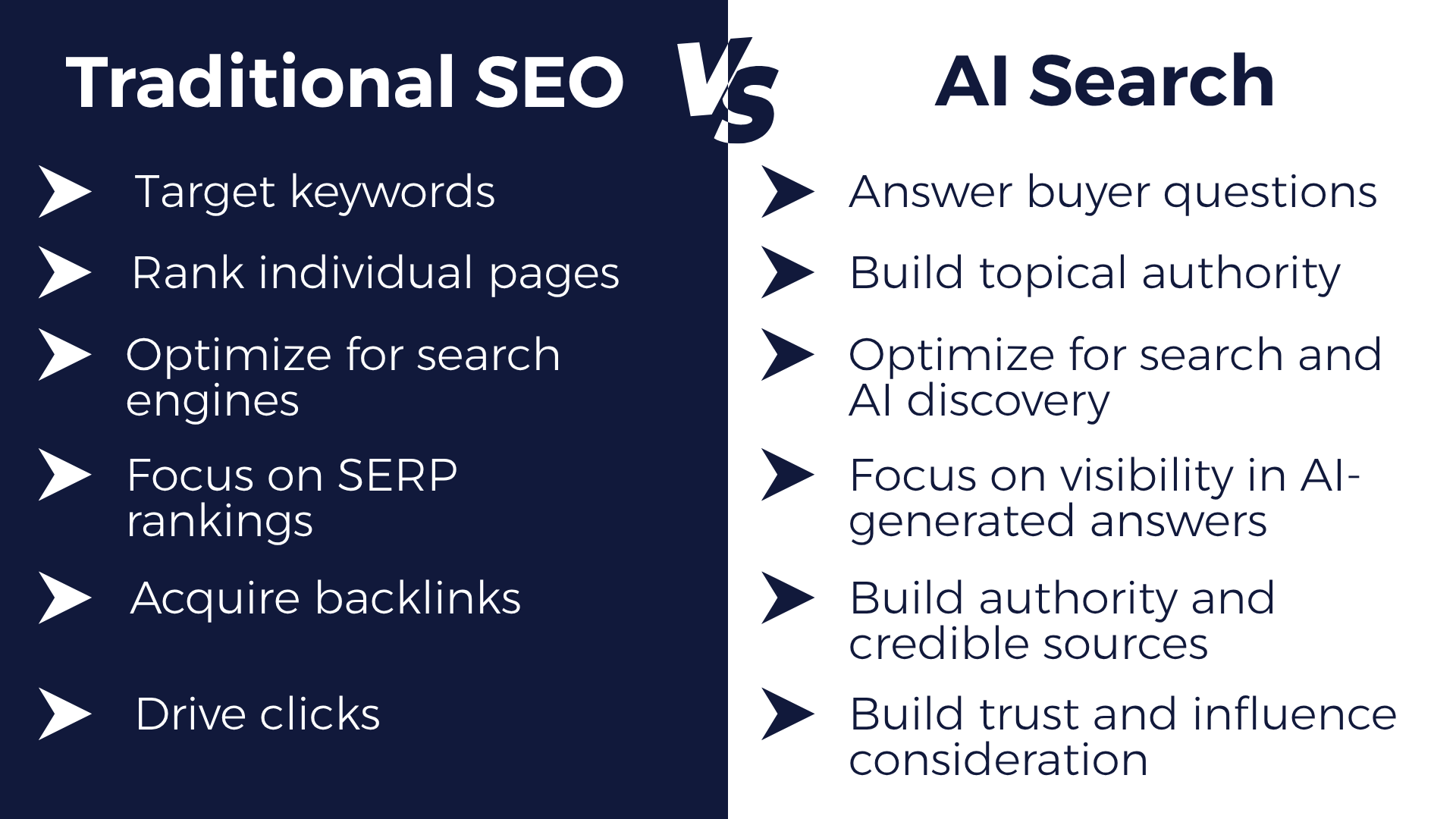
The strongest strategy isn't SEO versus AI SEO.

It's SEO plus AI search optimization.

1. Create Content Around Real Buyer Questions

One of the biggest changes B2B marketers should make is moving away from content created solely because a keyword has search volume.

Instead, ask:

What questions are our buyers actually asking?

For example, a B2B demand generation company could create content around:

  • What is B2B demand generation?
  • How does demand generation differ from lead generation?
  • How much should a B2B company spend on demand generation?
  • What channels work best for B2B demand generation?
  • How do you measure demand generation ROI?
  • Should B2B companies outsource demand generation?
  • How is AI changing B2B demand generation?

Each question can become a useful piece of content.

Over time, these articles, guides, case studies, and resources create a connected body of expertise around a specific subject.

This is where B2B demand generation and AI search optimization can work together.

2. Write for Humans, Not Just Algorithms

AI has made it even more important to create content that is genuinely useful.

Avoid producing articles that simply repeat a keyword dozens of times.

Instead:

  • Answer questions directly.
  • Use clear headings.
  • Explain complex concepts in plain language.
  • Include examples.
  • Provide original insights.
  • Reference credible sources.
  • Demonstrate real-world experience.
  • Keep information current.

Google's Search Central guidance on creating helpful, reliable, people-first content reinforces the importance of creating content primarily for people rather than manipulating search rankings.

The same principle applies to AI search.

If the content isn't useful to a human reader, it is unlikely to become a strong foundation for long-term search visibility.

3. Build Topical Authority

One article about a topic is rarely enough to establish meaningful expertise.

Imagine a company wants to be recognized for B2B demand generation.

Instead of publishing one article titled "What Is B2B Demand Generation?", build a content ecosystem covering:

Foundational content

  • What is B2B demand generation?
  • Demand generation vs. lead generation

Strategy

  • B2B demand generation strategy
  • B2B content strategy
  • Account-based marketing

Channels

  • LinkedIn for B2B marketing
  • Paid search
  • Email marketing
  • Content marketing

Measurement

  • Demand generation KPIs
  • Cost per qualified lead
  • Pipeline contribution
  • Marketing attribution

Emerging trends

  • AI and B2B demand generation
  • Conversational AI
  • AI-powered search
  • The future of B2B marketing

This creates a deeper knowledge base.

It also gives search engines and AI systems more context about what your organization knows and where your expertise lies.

4. Make Your Content Easy for AI to Understand

Clear structure matters.

Use descriptive headings, concise paragraphs, lists, tables, definitions, and direct answers.

For example, instead of beginning an article with five paragraphs of background information, answer the question immediately.

What Is B2B Demand Generation?

B2B demand generation is the process of creating awareness and interest in a company's products or services among potential business buyers, with the goal of building future demand and contributing to a qualified pipeline.

Then expand on the subject.

This structure benefits readers because they can quickly find the answer they need.

It also makes the information easier for search systems and AI-powered tools to interpret.

5. Strengthen Your Company's Authority

AI search isn't simply about publishing more content.

Your organization also needs to demonstrate that it is a credible source.

That means building:

  • Author expertise
  • Company expertise
  • Original research
  • Case studies
  • Customer experiences
  • Industry insights
  • Expert commentary
  • Credible citations
  • High-quality external references

For example, The Digital Funnel's own research and insights can become valuable assets for building authority.

A B2B Demand Generation Report can provide original data that other websites and marketers can reference.

Original research is particularly powerful because it gives your brand something that generic AI-generated articles cannot easily reproduce:

first-party knowledge.

6. Use Internal Linking to Build Context

Internal linking has always been an important SEO practice, but it becomes even more useful as you build a larger content ecosystem.

Instead of publishing disconnected blog posts, connect related topics.

For example:

B2B Demand Generation

AI Demand Generation

Conversational AI

B2B Content Strategy

Lead Generation

Marketing Automation

This creates pathways for both readers and search engines to understand how your content relates.

For example, readers interested in AI-powered demand generation can explore The Digital Funnel's AI Demand Generation resource for additional information.

The goal is to create a knowledge network, not simply a collection of blog posts.

7. Don't Ignore Google

One common mistake is assuming that ChatGPT SEO means abandoning Google.

It doesn't.

Google continues to be a major source of B2B discovery, while AI features are becoming increasingly integrated into the search experience.

Google's AI features and AI Overviews documentation provides information about how AI-powered features are incorporated into Google Search.

The better strategy is to create content that can perform well across multiple discovery environments.

Think:

Google Search + AI Overviews + ChatGPT + other AI discovery experiences + social search

The boundaries between search, social media, and AI discovery are becoming increasingly blurred.

8. Think Beyond Website Traffic

Perhaps the biggest strategic change is measurement.

For years, marketers have focused heavily on:

  • Organic traffic
  • Keyword rankings
  • Click-through rates
  • Backlinks
  • Page views

These metrics still matter.

But B2B marketers should increasingly ask:

Is our brand appearing during the buyer's research process?

A prospect may encounter your company through an AI-generated answer, visit your website later through another channel, and eventually become a lead.

That makes attribution more complicated.

Your measurement framework should therefore connect:

AI/Search Visibility → Website Engagement → Lead Generation → Qualified Leads → Pipeline → Revenue

The ultimate goal isn't simply to be mentioned by an AI system.

The goal is to become part of the buyer's consideration set.

What B2B Marketers Should Do Now

If your company wants to prepare for AI-powered search, start with these five steps:

1. Audit your existing content

Identify your strongest content and determine which buyer questions are still unanswered.

2. Build topic clusters

Group related content around your most important products, services, industries, and customer problems.

3. Create original insights

Publish research, statistics, case studies, expert opinions, and real-world experiences.

4. Improve internal linking

Connect related pages so readers and search systems can easily navigate your expertise.

5. Monitor AI visibility

Test how your company, products, competitors, and key topics appear in AI-powered search experiences and use those observations to identify content gaps.

The Future of B2B Search Is Conversational

B2B buyers aren't necessarily abandoning search.

They're changing how they search.

Instead of entering a few keywords and sorting through pages of results, they can increasingly ask detailed questions and expect synthesized answers.

That creates both a challenge and an opportunity.

Companies that continue producing generic, keyword-focused content may struggle to stand out.

Companies that build genuine expertise, answer buyer questions, publish original insights, and create interconnected content ecosystems will be better positioned for the next generation of search.

ChatGPT SEO isn't about trying to trick AI into mentioning your company.

It's about making your company the kind of credible, useful, authoritative source that AI-powered search experiences can understand and trust.

And that is ultimately what good SEO has always been about.

Ready to Build a B2B Search Strategy for the AI Era?

The Digital Funnel helps B2B organizations turn content, demand generation, paid media, and digital strategy into measurable business growth.

Want to make your brand more visible to today's increasingly AI-driven B2B buyers?

Talk to The Digital Funnel to explore how we can help strengthen your B2B demand generation and digital marketing strategy.


Frequently Asked Questions

What is ChatGPT SEO?

ChatGPT SEO is the process of optimizing B2B content so AI-powered search platforms can understand, discover, and potentially reference a company’s expertise, products, and services.

How is AI search optimization different from traditional SEO?

AI search optimization focuses on answering buyer questions, building topical authority, and improving visibility in AI-generated answers, while traditional SEO focuses more on keywords, rankings, and search engine visibility.

How can B2B companies improve visibility in ChatGPT search?

B2B companies can improve ChatGPT visibility by creating helpful, authoritative content, answering relevant buyer questions, building topical authority, and maintaining credible information across their digital presence.

Does traditional SEO still matter for AI search?

Yes. Traditional SEO remains important for AI search optimization. High-quality content, technical SEO, authoritative backlinks, clear site structure, and strong user experience continue to support B2B search visibility.

How can businesses optimize content for AI search?

Businesses can optimize content for AI search by covering topics comprehensively, answering conversational buyer questions, demonstrating expertise, building credible sources, and creating useful people-first content.

Author
Vinoth Kumar
Marketing Manager

Marketing Manager at The Digital Funnel and a B2B marketing strategist with over 10 years of experience. He specializes in AI driven marketing, demand generation, account based marketing, and content strategy, sharing practical insights that help businesses build trust, generate qualified demand, and drive sustainable growth.

Never miss a thing

Subscribe to our newsletter and you will always have our latest blog posts, reports, checklists, infographics and news on your inbox.

We promise not to send you lots of emails, only once a week, on Tuesdays.

Published on
August 25, 2026
Audio version
How To Guides
0:00
0:00

ChatGPT SEO: How AI Is Changing B2B Search

For years, B2B marketers have optimized content around one fundamental idea: get found on Google.

That strategy is still important, but the way B2B buyers discover information is changing.

Instead of typing a query into Google, scanning ten blue links, and opening multiple websites, buyers can now ask AI platforms questions and receive a synthesized answer in seconds. ChatGPT, Google AI Overviews and other AI-powered search experiences are changing how people research vendors, compare solutions, understand industries, and make purchasing decisions.

For B2B marketers, this creates a new challenge:

How do you make sure your company and content are visible when the search experience no longer ends with a list of links?

The answer is not to abandon traditional SEO. Instead, B2B marketers need to expand their approach to include ChatGPT SEO, AI search optimization, and content designed to be useful in AI-generated answers.

What Is ChatGPT SEO?

ChatGPT SEO refers to the process of creating and optimizing content so that a company has a better chance of being discovered, referenced, or represented accurately in AI-powered search experiences such as ChatGPT.

Traditional SEO primarily focuses on helping search engines understand and rank webpages.

AI search introduces another layer.

AI systems need to understand:

  • What your company does
  • What topics you have expertise in
  • Which questions your content answers
  • How trustworthy and authoritative your information is
  • How your products or services compare with alternatives
  • Whether your content provides useful, specific information

This means B2B marketers need to think beyond keywords and rankings.

The goal becomes becoming a credible source of information that AI systems can understand, retrieve, and potentially reference.

OpenAI's official information about ChatGPT Search explains how ChatGPT can search the web and provide answers with links to relevant sources.

That shift has major implications for B2B marketing.

Why AI Is Changing B2B Search

B2B purchasing has always involved extensive research.

A buyer evaluating marketing automation software, cybersecurity solutions, CRM platforms, or demand generation services may conduct dozens of searches before speaking with a salesperson.

AI can compress that research process.

Instead of searching:

"best B2B demand generation agencies"

A buyer might ask:

"What should a B2B company look for when choosing a demand generation agency?"

Or:

"Compare demand generation agencies that specialize in B2B technology companies."

Or:

"What are the most effective B2B demand generation strategies in 2026?"

These are more conversational and often more complex than traditional keyword searches.

That means B2B SEO needs to evolve from optimizing primarily for individual search queries to building topical authority around the questions buyers actually ask.

Traditional SEO vs. AI Search Optimization

Traditional SEO isn't disappearing. In fact, many of the fundamentals remain essential.

High-quality content, technical SEO, authoritative links, clear site architecture, and a strong user experience continue to matter.

But AI search adds new considerations.

The strongest strategy isn't SEO versus AI SEO.

It's SEO plus AI search optimization.

1. Create Content Around Real Buyer Questions

One of the biggest changes B2B marketers should make is moving away from content created solely because a keyword has search volume.

Instead, ask:

What questions are our buyers actually asking?

For example, a B2B demand generation company could create content around:

  • What is B2B demand generation?
  • How does demand generation differ from lead generation?
  • How much should a B2B company spend on demand generation?
  • What channels work best for B2B demand generation?
  • How do you measure demand generation ROI?
  • Should B2B companies outsource demand generation?
  • How is AI changing B2B demand generation?

Each question can become a useful piece of content.

Over time, these articles, guides, case studies, and resources create a connected body of expertise around a specific subject.

This is where B2B demand generation and AI search optimization can work together.

2. Write for Humans, Not Just Algorithms

AI has made it even more important to create content that is genuinely useful.

Avoid producing articles that simply repeat a keyword dozens of times.

Instead:

  • Answer questions directly.
  • Use clear headings.
  • Explain complex concepts in plain language.
  • Include examples.
  • Provide original insights.
  • Reference credible sources.
  • Demonstrate real-world experience.
  • Keep information current.

Google's Search Central guidance on creating helpful, reliable, people-first content reinforces the importance of creating content primarily for people rather than manipulating search rankings.

The same principle applies to AI search.

If the content isn't useful to a human reader, it is unlikely to become a strong foundation for long-term search visibility.

3. Build Topical Authority

One article about a topic is rarely enough to establish meaningful expertise.

Imagine a company wants to be recognized for B2B demand generation.

Instead of publishing one article titled "What Is B2B Demand Generation?", build a content ecosystem covering:

Foundational content

  • What is B2B demand generation?
  • Demand generation vs. lead generation

Strategy

  • B2B demand generation strategy
  • B2B content strategy
  • Account-based marketing

Channels

  • LinkedIn for B2B marketing
  • Paid search
  • Email marketing
  • Content marketing

Measurement

  • Demand generation KPIs
  • Cost per qualified lead
  • Pipeline contribution
  • Marketing attribution

Emerging trends

  • AI and B2B demand generation
  • Conversational AI
  • AI-powered search
  • The future of B2B marketing

This creates a deeper knowledge base.

It also gives search engines and AI systems more context about what your organization knows and where your expertise lies.

4. Make Your Content Easy for AI to Understand

Clear structure matters.

Use descriptive headings, concise paragraphs, lists, tables, definitions, and direct answers.

For example, instead of beginning an article with five paragraphs of background information, answer the question immediately.

What Is B2B Demand Generation?

B2B demand generation is the process of creating awareness and interest in a company's products or services among potential business buyers, with the goal of building future demand and contributing to a qualified pipeline.

Then expand on the subject.

This structure benefits readers because they can quickly find the answer they need.

It also makes the information easier for search systems and AI-powered tools to interpret.

5. Strengthen Your Company's Authority

AI search isn't simply about publishing more content.

Your organization also needs to demonstrate that it is a credible source.

That means building:

  • Author expertise
  • Company expertise
  • Original research
  • Case studies
  • Customer experiences
  • Industry insights
  • Expert commentary
  • Credible citations
  • High-quality external references

For example, The Digital Funnel's own research and insights can become valuable assets for building authority.

A B2B Demand Generation Report can provide original data that other websites and marketers can reference.

Original research is particularly powerful because it gives your brand something that generic AI-generated articles cannot easily reproduce:

first-party knowledge.

6. Use Internal Linking to Build Context

Internal linking has always been an important SEO practice, but it becomes even more useful as you build a larger content ecosystem.

Instead of publishing disconnected blog posts, connect related topics.

For example:

B2B Demand Generation

AI Demand Generation

Conversational AI

B2B Content Strategy

Lead Generation

Marketing Automation

This creates pathways for both readers and search engines to understand how your content relates.

For example, readers interested in AI-powered demand generation can explore The Digital Funnel's AI Demand Generation resource for additional information.

The goal is to create a knowledge network, not simply a collection of blog posts.

7. Don't Ignore Google

One common mistake is assuming that ChatGPT SEO means abandoning Google.

It doesn't.

Google continues to be a major source of B2B discovery, while AI features are becoming increasingly integrated into the search experience.

Google's AI features and AI Overviews documentation provides information about how AI-powered features are incorporated into Google Search.

The better strategy is to create content that can perform well across multiple discovery environments.

Think:

Google Search + AI Overviews + ChatGPT + other AI discovery experiences + social search

The boundaries between search, social media, and AI discovery are becoming increasingly blurred.

8. Think Beyond Website Traffic

Perhaps the biggest strategic change is measurement.

For years, marketers have focused heavily on:

  • Organic traffic
  • Keyword rankings
  • Click-through rates
  • Backlinks
  • Page views

These metrics still matter.

But B2B marketers should increasingly ask:

Is our brand appearing during the buyer's research process?

A prospect may encounter your company through an AI-generated answer, visit your website later through another channel, and eventually become a lead.

That makes attribution more complicated.

Your measurement framework should therefore connect:

AI/Search Visibility → Website Engagement → Lead Generation → Qualified Leads → Pipeline → Revenue

The ultimate goal isn't simply to be mentioned by an AI system.

The goal is to become part of the buyer's consideration set.

What B2B Marketers Should Do Now

If your company wants to prepare for AI-powered search, start with these five steps:

1. Audit your existing content

Identify your strongest content and determine which buyer questions are still unanswered.

2. Build topic clusters

Group related content around your most important products, services, industries, and customer problems.

3. Create original insights

Publish research, statistics, case studies, expert opinions, and real-world experiences.

4. Improve internal linking

Connect related pages so readers and search systems can easily navigate your expertise.

5. Monitor AI visibility

Test how your company, products, competitors, and key topics appear in AI-powered search experiences and use those observations to identify content gaps.

The Future of B2B Search Is Conversational

B2B buyers aren't necessarily abandoning search.

They're changing how they search.

Instead of entering a few keywords and sorting through pages of results, they can increasingly ask detailed questions and expect synthesized answers.

That creates both a challenge and an opportunity.

Companies that continue producing generic, keyword-focused content may struggle to stand out.

Companies that build genuine expertise, answer buyer questions, publish original insights, and create interconnected content ecosystems will be better positioned for the next generation of search.

ChatGPT SEO isn't about trying to trick AI into mentioning your company.

It's about making your company the kind of credible, useful, authoritative source that AI-powered search experiences can understand and trust.

And that is ultimately what good SEO has always been about.

Ready to Build a B2B Search Strategy for the AI Era?

The Digital Funnel helps B2B organizations turn content, demand generation, paid media, and digital strategy into measurable business growth.

Want to make your brand more visible to today's increasingly AI-driven B2B buyers?

Talk to The Digital Funnel to explore how we can help strengthen your B2B demand generation and digital marketing strategy.

Frequently Asked Questions

What is ChatGPT SEO?

ChatGPT SEO is the process of optimizing B2B content so AI-powered search platforms can understand, discover, and potentially reference a company’s expertise, products, and services.

How is AI search optimization different from traditional SEO?

AI search optimization focuses on answering buyer questions, building topical authority, and improving visibility in AI-generated answers, while traditional SEO focuses more on keywords, rankings, and search engine visibility.

How can B2B companies improve visibility in ChatGPT search?

B2B companies can improve ChatGPT visibility by creating helpful, authoritative content, answering relevant buyer questions, building topical authority, and maintaining credible information across their digital presence.

Does traditional SEO still matter for AI search?

Yes. Traditional SEO remains important for AI search optimization. High-quality content, technical SEO, authoritative backlinks, clear site structure, and strong user experience continue to support B2B search visibility.

How can businesses optimize content for AI search?

Businesses can optimize content for AI search by covering topics comprehensively, answering conversational buyer questions, demonstrating expertise, building credible sources, and creating useful people-first content.

Author
Vinoth Kumar
Marketing Manager

Marketing Manager at The Digital Funnel and a B2B marketing strategist with over 10 years of experience. He specializes in AI driven marketing, demand generation, account based marketing, and content strategy, sharing practical insights that help businesses build trust, generate qualified demand, and drive sustainable growth.

Never miss a thing

Subscribe to our newsletter and you will always have our latest blog posts, reports, checklists, infographics and news on your inbox.

We promise not to send you lots of emails, only once a week, on Tuesdays.

Published on
August 25, 2026

ChatGPT SEO: How AI Is Changing B2B Search

For years, B2B marketers have optimized content around one fundamental idea: get found on Google.

That strategy is still important, but the way B2B buyers discover information is changing.

Instead of typing a query into Google, scanning ten blue links, and opening multiple websites, buyers can now ask AI platforms questions and receive a synthesized answer in seconds. ChatGPT, Google AI Overviews and other AI-powered search experiences are changing how people research vendors, compare solutions, understand industries, and make purchasing decisions.

For B2B marketers, this creates a new challenge:

How do you make sure your company and content are visible when the search experience no longer ends with a list of links?

The answer is not to abandon traditional SEO. Instead, B2B marketers need to expand their approach to include ChatGPT SEO, AI search optimization, and content designed to be useful in AI-generated answers.

What Is ChatGPT SEO?

ChatGPT SEO refers to the process of creating and optimizing content so that a company has a better chance of being discovered, referenced, or represented accurately in AI-powered search experiences such as ChatGPT.

Traditional SEO primarily focuses on helping search engines understand and rank webpages.

AI search introduces another layer.

AI systems need to understand:

  • What your company does
  • What topics you have expertise in
  • Which questions your content answers
  • How trustworthy and authoritative your information is
  • How your products or services compare with alternatives
  • Whether your content provides useful, specific information

This means B2B marketers need to think beyond keywords and rankings.

The goal becomes becoming a credible source of information that AI systems can understand, retrieve, and potentially reference.

OpenAI's official information about ChatGPT Search explains how ChatGPT can search the web and provide answers with links to relevant sources.

That shift has major implications for B2B marketing.

Why AI Is Changing B2B Search

B2B purchasing has always involved extensive research.

A buyer evaluating marketing automation software, cybersecurity solutions, CRM platforms, or demand generation services may conduct dozens of searches before speaking with a salesperson.

AI can compress that research process.

Instead of searching:

"best B2B demand generation agencies"

A buyer might ask:

"What should a B2B company look for when choosing a demand generation agency?"

Or:

"Compare demand generation agencies that specialize in B2B technology companies."

Or:

"What are the most effective B2B demand generation strategies in 2026?"

These are more conversational and often more complex than traditional keyword searches.

That means B2B SEO needs to evolve from optimizing primarily for individual search queries to building topical authority around the questions buyers actually ask.

Traditional SEO vs. AI Search Optimization

Traditional SEO isn't disappearing. In fact, many of the fundamentals remain essential.

High-quality content, technical SEO, authoritative links, clear site architecture, and a strong user experience continue to matter.

But AI search adds new considerations.

The strongest strategy isn't SEO versus AI SEO.

It's SEO plus AI search optimization.

1. Create Content Around Real Buyer Questions

One of the biggest changes B2B marketers should make is moving away from content created solely because a keyword has search volume.

Instead, ask:

What questions are our buyers actually asking?

For example, a B2B demand generation company could create content around:

  • What is B2B demand generation?
  • How does demand generation differ from lead generation?
  • How much should a B2B company spend on demand generation?
  • What channels work best for B2B demand generation?
  • How do you measure demand generation ROI?
  • Should B2B companies outsource demand generation?
  • How is AI changing B2B demand generation?

Each question can become a useful piece of content.

Over time, these articles, guides, case studies, and resources create a connected body of expertise around a specific subject.

This is where B2B demand generation and AI search optimization can work together.

2. Write for Humans, Not Just Algorithms

AI has made it even more important to create content that is genuinely useful.

Avoid producing articles that simply repeat a keyword dozens of times.

Instead:

  • Answer questions directly.
  • Use clear headings.
  • Explain complex concepts in plain language.
  • Include examples.
  • Provide original insights.
  • Reference credible sources.
  • Demonstrate real-world experience.
  • Keep information current.

Google's Search Central guidance on creating helpful, reliable, people-first content reinforces the importance of creating content primarily for people rather than manipulating search rankings.

The same principle applies to AI search.

If the content isn't useful to a human reader, it is unlikely to become a strong foundation for long-term search visibility.

3. Build Topical Authority

One article about a topic is rarely enough to establish meaningful expertise.

Imagine a company wants to be recognized for B2B demand generation.

Instead of publishing one article titled "What Is B2B Demand Generation?", build a content ecosystem covering:

Foundational content

  • What is B2B demand generation?
  • Demand generation vs. lead generation

Strategy

  • B2B demand generation strategy
  • B2B content strategy
  • Account-based marketing

Channels

  • LinkedIn for B2B marketing
  • Paid search
  • Email marketing
  • Content marketing

Measurement

  • Demand generation KPIs
  • Cost per qualified lead
  • Pipeline contribution
  • Marketing attribution

Emerging trends

  • AI and B2B demand generation
  • Conversational AI
  • AI-powered search
  • The future of B2B marketing

This creates a deeper knowledge base.

It also gives search engines and AI systems more context about what your organization knows and where your expertise lies.

4. Make Your Content Easy for AI to Understand

Clear structure matters.

Use descriptive headings, concise paragraphs, lists, tables, definitions, and direct answers.

For example, instead of beginning an article with five paragraphs of background information, answer the question immediately.

What Is B2B Demand Generation?

B2B demand generation is the process of creating awareness and interest in a company's products or services among potential business buyers, with the goal of building future demand and contributing to a qualified pipeline.

Then expand on the subject.

This structure benefits readers because they can quickly find the answer they need.

It also makes the information easier for search systems and AI-powered tools to interpret.

5. Strengthen Your Company's Authority

AI search isn't simply about publishing more content.

Your organization also needs to demonstrate that it is a credible source.

That means building:

  • Author expertise
  • Company expertise
  • Original research
  • Case studies
  • Customer experiences
  • Industry insights
  • Expert commentary
  • Credible citations
  • High-quality external references

For example, The Digital Funnel's own research and insights can become valuable assets for building authority.

A B2B Demand Generation Report can provide original data that other websites and marketers can reference.

Original research is particularly powerful because it gives your brand something that generic AI-generated articles cannot easily reproduce:

first-party knowledge.

6. Use Internal Linking to Build Context

Internal linking has always been an important SEO practice, but it becomes even more useful as you build a larger content ecosystem.

Instead of publishing disconnected blog posts, connect related topics.

For example:

B2B Demand Generation

AI Demand Generation

Conversational AI

B2B Content Strategy

Lead Generation

Marketing Automation

This creates pathways for both readers and search engines to understand how your content relates.

For example, readers interested in AI-powered demand generation can explore The Digital Funnel's AI Demand Generation resource for additional information.

The goal is to create a knowledge network, not simply a collection of blog posts.

7. Don't Ignore Google

One common mistake is assuming that ChatGPT SEO means abandoning Google.

It doesn't.

Google continues to be a major source of B2B discovery, while AI features are becoming increasingly integrated into the search experience.

Google's AI features and AI Overviews documentation provides information about how AI-powered features are incorporated into Google Search.

The better strategy is to create content that can perform well across multiple discovery environments.

Think:

Google Search + AI Overviews + ChatGPT + other AI discovery experiences + social search

The boundaries between search, social media, and AI discovery are becoming increasingly blurred.

8. Think Beyond Website Traffic

Perhaps the biggest strategic change is measurement.

For years, marketers have focused heavily on:

  • Organic traffic
  • Keyword rankings
  • Click-through rates
  • Backlinks
  • Page views

These metrics still matter.

But B2B marketers should increasingly ask:

Is our brand appearing during the buyer's research process?

A prospect may encounter your company through an AI-generated answer, visit your website later through another channel, and eventually become a lead.

That makes attribution more complicated.

Your measurement framework should therefore connect:

AI/Search Visibility → Website Engagement → Lead Generation → Qualified Leads → Pipeline → Revenue

The ultimate goal isn't simply to be mentioned by an AI system.

The goal is to become part of the buyer's consideration set.

What B2B Marketers Should Do Now

If your company wants to prepare for AI-powered search, start with these five steps:

1. Audit your existing content

Identify your strongest content and determine which buyer questions are still unanswered.

2. Build topic clusters

Group related content around your most important products, services, industries, and customer problems.

3. Create original insights

Publish research, statistics, case studies, expert opinions, and real-world experiences.

4. Improve internal linking

Connect related pages so readers and search systems can easily navigate your expertise.

5. Monitor AI visibility

Test how your company, products, competitors, and key topics appear in AI-powered search experiences and use those observations to identify content gaps.

The Future of B2B Search Is Conversational

B2B buyers aren't necessarily abandoning search.

They're changing how they search.

Instead of entering a few keywords and sorting through pages of results, they can increasingly ask detailed questions and expect synthesized answers.

That creates both a challenge and an opportunity.

Companies that continue producing generic, keyword-focused content may struggle to stand out.

Companies that build genuine expertise, answer buyer questions, publish original insights, and create interconnected content ecosystems will be better positioned for the next generation of search.

ChatGPT SEO isn't about trying to trick AI into mentioning your company.

It's about making your company the kind of credible, useful, authoritative source that AI-powered search experiences can understand and trust.

And that is ultimately what good SEO has always been about.

Ready to Build a B2B Search Strategy for the AI Era?

The Digital Funnel helps B2B organizations turn content, demand generation, paid media, and digital strategy into measurable business growth.

Want to make your brand more visible to today's increasingly AI-driven B2B buyers?

Talk to The Digital Funnel to explore how we can help strengthen your B2B demand generation and digital marketing strategy.
Frequently Asked Questions

What is ChatGPT SEO?

ChatGPT SEO is the process of optimizing B2B content so AI-powered search platforms can understand, discover, and potentially reference a company’s expertise, products, and services.

How is AI search optimization different from traditional SEO?

AI search optimization focuses on answering buyer questions, building topical authority, and improving visibility in AI-generated answers, while traditional SEO focuses more on keywords, rankings, and search engine visibility.

How can B2B companies improve visibility in ChatGPT search?

B2B companies can improve ChatGPT visibility by creating helpful, authoritative content, answering relevant buyer questions, building topical authority, and maintaining credible information across their digital presence.

Does traditional SEO still matter for AI search?

Yes. Traditional SEO remains important for AI search optimization. High-quality content, technical SEO, authoritative backlinks, clear site structure, and strong user experience continue to support B2B search visibility.

How can businesses optimize content for AI search?

Businesses can optimize content for AI search by covering topics comprehensively, answering conversational buyer questions, demonstrating expertise, building credible sources, and creating useful people-first content.

Author
Vinoth Kumar
Marketing Manager

Marketing Manager at The Digital Funnel and a B2B marketing strategist with over 10 years of experience. He specializes in AI driven marketing, demand generation, account based marketing, and content strategy, sharing practical insights that help businesses build trust, generate qualified demand, and drive sustainable growth.

Never miss a thing

Subscribe to our newsletter and you will always have our latest blog posts, reports, checklists, infographics and news on your inbox.

We promise not to send you lots of emails, only once a week, on Tuesdays.

Published on
August 25, 2026

ChatGPT SEO: How AI Is Changing B2B Search

For years, B2B marketers have optimized content around one fundamental idea: get found on Google.

That strategy is still important, but the way B2B buyers discover information is changing.

Instead of typing a query into Google, scanning ten blue links, and opening multiple websites, buyers can now ask AI platforms questions and receive a synthesized answer in seconds. ChatGPT, Google AI Overviews and other AI-powered search experiences are changing how people research vendors, compare solutions, understand industries, and make purchasing decisions.

For B2B marketers, this creates a new challenge:

How do you make sure your company and content are visible when the search experience no longer ends with a list of links?

The answer is not to abandon traditional SEO. Instead, B2B marketers need to expand their approach to include ChatGPT SEO, AI search optimization, and content designed to be useful in AI-generated answers.

What Is ChatGPT SEO?

ChatGPT SEO refers to the process of creating and optimizing content so that a company has a better chance of being discovered, referenced, or represented accurately in AI-powered search experiences such as ChatGPT.

Traditional SEO primarily focuses on helping search engines understand and rank webpages.

AI search introduces another layer.

AI systems need to understand:

  • What your company does
  • What topics you have expertise in
  • Which questions your content answers
  • How trustworthy and authoritative your information is
  • How your products or services compare with alternatives
  • Whether your content provides useful, specific information

This means B2B marketers need to think beyond keywords and rankings.

The goal becomes becoming a credible source of information that AI systems can understand, retrieve, and potentially reference.

OpenAI's official information about ChatGPT Search explains how ChatGPT can search the web and provide answers with links to relevant sources.

That shift has major implications for B2B marketing.

Why AI Is Changing B2B Search

B2B purchasing has always involved extensive research.

A buyer evaluating marketing automation software, cybersecurity solutions, CRM platforms, or demand generation services may conduct dozens of searches before speaking with a salesperson.

AI can compress that research process.

Instead of searching:

"best B2B demand generation agencies"

A buyer might ask:

"What should a B2B company look for when choosing a demand generation agency?"

Or:

"Compare demand generation agencies that specialize in B2B technology companies."

Or:

"What are the most effective B2B demand generation strategies in 2026?"

These are more conversational and often more complex than traditional keyword searches.

That means B2B SEO needs to evolve from optimizing primarily for individual search queries to building topical authority around the questions buyers actually ask.

Traditional SEO vs. AI Search Optimization

Traditional SEO isn't disappearing. In fact, many of the fundamentals remain essential.

High-quality content, technical SEO, authoritative links, clear site architecture, and a strong user experience continue to matter.

But AI search adds new considerations.

The strongest strategy isn't SEO versus AI SEO.

It's SEO plus AI search optimization.

1. Create Content Around Real Buyer Questions

One of the biggest changes B2B marketers should make is moving away from content created solely because a keyword has search volume.

Instead, ask:

What questions are our buyers actually asking?

For example, a B2B demand generation company could create content around:

  • What is B2B demand generation?
  • How does demand generation differ from lead generation?
  • How much should a B2B company spend on demand generation?
  • What channels work best for B2B demand generation?
  • How do you measure demand generation ROI?
  • Should B2B companies outsource demand generation?
  • How is AI changing B2B demand generation?

Each question can become a useful piece of content.

Over time, these articles, guides, case studies, and resources create a connected body of expertise around a specific subject.

This is where B2B demand generation and AI search optimization can work together.

2. Write for Humans, Not Just Algorithms

AI has made it even more important to create content that is genuinely useful.

Avoid producing articles that simply repeat a keyword dozens of times.

Instead:

  • Answer questions directly.
  • Use clear headings.
  • Explain complex concepts in plain language.
  • Include examples.
  • Provide original insights.
  • Reference credible sources.
  • Demonstrate real-world experience.
  • Keep information current.

Google's Search Central guidance on creating helpful, reliable, people-first content reinforces the importance of creating content primarily for people rather than manipulating search rankings.

The same principle applies to AI search.

If the content isn't useful to a human reader, it is unlikely to become a strong foundation for long-term search visibility.

3. Build Topical Authority

One article about a topic is rarely enough to establish meaningful expertise.

Imagine a company wants to be recognized for B2B demand generation.

Instead of publishing one article titled "What Is B2B Demand Generation?", build a content ecosystem covering:

Foundational content

  • What is B2B demand generation?
  • Demand generation vs. lead generation

Strategy

  • B2B demand generation strategy
  • B2B content strategy
  • Account-based marketing

Channels

  • LinkedIn for B2B marketing
  • Paid search
  • Email marketing
  • Content marketing

Measurement

  • Demand generation KPIs
  • Cost per qualified lead
  • Pipeline contribution
  • Marketing attribution

Emerging trends

  • AI and B2B demand generation
  • Conversational AI
  • AI-powered search
  • The future of B2B marketing

This creates a deeper knowledge base.

It also gives search engines and AI systems more context about what your organization knows and where your expertise lies.

4. Make Your Content Easy for AI to Understand

Clear structure matters.

Use descriptive headings, concise paragraphs, lists, tables, definitions, and direct answers.

For example, instead of beginning an article with five paragraphs of background information, answer the question immediately.

What Is B2B Demand Generation?

B2B demand generation is the process of creating awareness and interest in a company's products or services among potential business buyers, with the goal of building future demand and contributing to a qualified pipeline.

Then expand on the subject.

This structure benefits readers because they can quickly find the answer they need.

It also makes the information easier for search systems and AI-powered tools to interpret.

5. Strengthen Your Company's Authority

AI search isn't simply about publishing more content.

Your organization also needs to demonstrate that it is a credible source.

That means building:

  • Author expertise
  • Company expertise
  • Original research
  • Case studies
  • Customer experiences
  • Industry insights
  • Expert commentary
  • Credible citations
  • High-quality external references

For example, The Digital Funnel's own research and insights can become valuable assets for building authority.

A B2B Demand Generation Report can provide original data that other websites and marketers can reference.

Original research is particularly powerful because it gives your brand something that generic AI-generated articles cannot easily reproduce:

first-party knowledge.

6. Use Internal Linking to Build Context

Internal linking has always been an important SEO practice, but it becomes even more useful as you build a larger content ecosystem.

Instead of publishing disconnected blog posts, connect related topics.

For example:

B2B Demand Generation

AI Demand Generation

Conversational AI

B2B Content Strategy

Lead Generation

Marketing Automation

This creates pathways for both readers and search engines to understand how your content relates.

For example, readers interested in AI-powered demand generation can explore The Digital Funnel's AI Demand Generation resource for additional information.

The goal is to create a knowledge network, not simply a collection of blog posts.

7. Don't Ignore Google

One common mistake is assuming that ChatGPT SEO means abandoning Google.

It doesn't.

Google continues to be a major source of B2B discovery, while AI features are becoming increasingly integrated into the search experience.

Google's AI features and AI Overviews documentation provides information about how AI-powered features are incorporated into Google Search.

The better strategy is to create content that can perform well across multiple discovery environments.

Think:

Google Search + AI Overviews + ChatGPT + other AI discovery experiences + social search

The boundaries between search, social media, and AI discovery are becoming increasingly blurred.

8. Think Beyond Website Traffic

Perhaps the biggest strategic change is measurement.

For years, marketers have focused heavily on:

  • Organic traffic
  • Keyword rankings
  • Click-through rates
  • Backlinks
  • Page views

These metrics still matter.

But B2B marketers should increasingly ask:

Is our brand appearing during the buyer's research process?

A prospect may encounter your company through an AI-generated answer, visit your website later through another channel, and eventually become a lead.

That makes attribution more complicated.

Your measurement framework should therefore connect:

AI/Search Visibility → Website Engagement → Lead Generation → Qualified Leads → Pipeline → Revenue

The ultimate goal isn't simply to be mentioned by an AI system.

The goal is to become part of the buyer's consideration set.

What B2B Marketers Should Do Now

If your company wants to prepare for AI-powered search, start with these five steps:

1. Audit your existing content

Identify your strongest content and determine which buyer questions are still unanswered.

2. Build topic clusters

Group related content around your most important products, services, industries, and customer problems.

3. Create original insights

Publish research, statistics, case studies, expert opinions, and real-world experiences.

4. Improve internal linking

Connect related pages so readers and search systems can easily navigate your expertise.

5. Monitor AI visibility

Test how your company, products, competitors, and key topics appear in AI-powered search experiences and use those observations to identify content gaps.

The Future of B2B Search Is Conversational

B2B buyers aren't necessarily abandoning search.

They're changing how they search.

Instead of entering a few keywords and sorting through pages of results, they can increasingly ask detailed questions and expect synthesized answers.

That creates both a challenge and an opportunity.

Companies that continue producing generic, keyword-focused content may struggle to stand out.

Companies that build genuine expertise, answer buyer questions, publish original insights, and create interconnected content ecosystems will be better positioned for the next generation of search.

ChatGPT SEO isn't about trying to trick AI into mentioning your company.

It's about making your company the kind of credible, useful, authoritative source that AI-powered search experiences can understand and trust.

And that is ultimately what good SEO has always been about.

Ready to Build a B2B Search Strategy for the AI Era?

The Digital Funnel helps B2B organizations turn content, demand generation, paid media, and digital strategy into measurable business growth.

Want to make your brand more visible to today's increasingly AI-driven B2B buyers?

Talk to The Digital Funnel to explore how we can help strengthen your B2B demand generation and digital marketing strategy.

Frequently Asked Questions

What is ChatGPT SEO?

ChatGPT SEO is the process of optimizing B2B content so AI-powered search platforms can understand, discover, and potentially reference a company’s expertise, products, and services.

How is AI search optimization different from traditional SEO?

AI search optimization focuses on answering buyer questions, building topical authority, and improving visibility in AI-generated answers, while traditional SEO focuses more on keywords, rankings, and search engine visibility.

How can B2B companies improve visibility in ChatGPT search?

B2B companies can improve ChatGPT visibility by creating helpful, authoritative content, answering relevant buyer questions, building topical authority, and maintaining credible information across their digital presence.

Does traditional SEO still matter for AI search?

Yes. Traditional SEO remains important for AI search optimization. High-quality content, technical SEO, authoritative backlinks, clear site structure, and strong user experience continue to support B2B search visibility.

How can businesses optimize content for AI search?

Businesses can optimize content for AI search by covering topics comprehensively, answering conversational buyer questions, demonstrating expertise, building credible sources, and creating useful people-first content.

Download your copy now!

Thank you! Your submission has been received!
Oops! Something went wrong while submitting the form.
Author
Vinoth Kumar
Marketing Manager

Marketing Manager at The Digital Funnel and a B2B marketing strategist with over 10 years of experience. He specializes in AI driven marketing, demand generation, account based marketing, and content strategy, sharing practical insights that help businesses build trust, generate qualified demand, and drive sustainable growth.

Never miss a thing

Subscribe to our newsletter and you will always have our latest blog posts, reports, checklists, infographics and news on your inbox.

We promise not to send you lots of emails, only once a week, on Tuesdays.

Published on
August 25, 2026

ChatGPT SEO: How AI Is Changing B2B Search

For years, B2B marketers have optimized content around one fundamental idea: get found on Google.

That strategy is still important, but the way B2B buyers discover information is changing.

Instead of typing a query into Google, scanning ten blue links, and opening multiple websites, buyers can now ask AI platforms questions and receive a synthesized answer in seconds. ChatGPT, Google AI Overviews and other AI-powered search experiences are changing how people research vendors, compare solutions, understand industries, and make purchasing decisions.

For B2B marketers, this creates a new challenge:

How do you make sure your company and content are visible when the search experience no longer ends with a list of links?

The answer is not to abandon traditional SEO. Instead, B2B marketers need to expand their approach to include ChatGPT SEO, AI search optimization, and content designed to be useful in AI-generated answers.

What Is ChatGPT SEO?

ChatGPT SEO refers to the process of creating and optimizing content so that a company has a better chance of being discovered, referenced, or represented accurately in AI-powered search experiences such as ChatGPT.

Traditional SEO primarily focuses on helping search engines understand and rank webpages.

AI search introduces another layer.

AI systems need to understand:

  • What your company does
  • What topics you have expertise in
  • Which questions your content answers
  • How trustworthy and authoritative your information is
  • How your products or services compare with alternatives
  • Whether your content provides useful, specific information

This means B2B marketers need to think beyond keywords and rankings.

The goal becomes becoming a credible source of information that AI systems can understand, retrieve, and potentially reference.

OpenAI's official information about ChatGPT Search explains how ChatGPT can search the web and provide answers with links to relevant sources.

That shift has major implications for B2B marketing.

Why AI Is Changing B2B Search

B2B purchasing has always involved extensive research.

A buyer evaluating marketing automation software, cybersecurity solutions, CRM platforms, or demand generation services may conduct dozens of searches before speaking with a salesperson.

AI can compress that research process.

Instead of searching:

"best B2B demand generation agencies"

A buyer might ask:

"What should a B2B company look for when choosing a demand generation agency?"

Or:

"Compare demand generation agencies that specialize in B2B technology companies."

Or:

"What are the most effective B2B demand generation strategies in 2026?"

These are more conversational and often more complex than traditional keyword searches.

That means B2B SEO needs to evolve from optimizing primarily for individual search queries to building topical authority around the questions buyers actually ask.

Traditional SEO vs. AI Search Optimization

Traditional SEO isn't disappearing. In fact, many of the fundamentals remain essential.

High-quality content, technical SEO, authoritative links, clear site architecture, and a strong user experience continue to matter.

But AI search adds new considerations.

The strongest strategy isn't SEO versus AI SEO.

It's SEO plus AI search optimization.

1. Create Content Around Real Buyer Questions

One of the biggest changes B2B marketers should make is moving away from content created solely because a keyword has search volume.

Instead, ask:

What questions are our buyers actually asking?

For example, a B2B demand generation company could create content around:

  • What is B2B demand generation?
  • How does demand generation differ from lead generation?
  • How much should a B2B company spend on demand generation?
  • What channels work best for B2B demand generation?
  • How do you measure demand generation ROI?
  • Should B2B companies outsource demand generation?
  • How is AI changing B2B demand generation?

Each question can become a useful piece of content.

Over time, these articles, guides, case studies, and resources create a connected body of expertise around a specific subject.

This is where B2B demand generation and AI search optimization can work together.

2. Write for Humans, Not Just Algorithms

AI has made it even more important to create content that is genuinely useful.

Avoid producing articles that simply repeat a keyword dozens of times.

Instead:

  • Answer questions directly.
  • Use clear headings.
  • Explain complex concepts in plain language.
  • Include examples.
  • Provide original insights.
  • Reference credible sources.
  • Demonstrate real-world experience.
  • Keep information current.

Google's Search Central guidance on creating helpful, reliable, people-first content reinforces the importance of creating content primarily for people rather than manipulating search rankings.

The same principle applies to AI search.

If the content isn't useful to a human reader, it is unlikely to become a strong foundation for long-term search visibility.

3. Build Topical Authority

One article about a topic is rarely enough to establish meaningful expertise.

Imagine a company wants to be recognized for B2B demand generation.

Instead of publishing one article titled "What Is B2B Demand Generation?", build a content ecosystem covering:

Foundational content

  • What is B2B demand generation?
  • Demand generation vs. lead generation

Strategy

  • B2B demand generation strategy
  • B2B content strategy
  • Account-based marketing

Channels

  • LinkedIn for B2B marketing
  • Paid search
  • Email marketing
  • Content marketing

Measurement

  • Demand generation KPIs
  • Cost per qualified lead
  • Pipeline contribution
  • Marketing attribution

Emerging trends

  • AI and B2B demand generation
  • Conversational AI
  • AI-powered search
  • The future of B2B marketing

This creates a deeper knowledge base.

It also gives search engines and AI systems more context about what your organization knows and where your expertise lies.

4. Make Your Content Easy for AI to Understand

Clear structure matters.

Use descriptive headings, concise paragraphs, lists, tables, definitions, and direct answers.

For example, instead of beginning an article with five paragraphs of background information, answer the question immediately.

What Is B2B Demand Generation?

B2B demand generation is the process of creating awareness and interest in a company's products or services among potential business buyers, with the goal of building future demand and contributing to a qualified pipeline.

Then expand on the subject.

This structure benefits readers because they can quickly find the answer they need.

It also makes the information easier for search systems and AI-powered tools to interpret.

5. Strengthen Your Company's Authority

AI search isn't simply about publishing more content.

Your organization also needs to demonstrate that it is a credible source.

That means building:

  • Author expertise
  • Company expertise
  • Original research
  • Case studies
  • Customer experiences
  • Industry insights
  • Expert commentary
  • Credible citations
  • High-quality external references

For example, The Digital Funnel's own research and insights can become valuable assets for building authority.

A B2B Demand Generation Report can provide original data that other websites and marketers can reference.

Original research is particularly powerful because it gives your brand something that generic AI-generated articles cannot easily reproduce:

first-party knowledge.

6. Use Internal Linking to Build Context

Internal linking has always been an important SEO practice, but it becomes even more useful as you build a larger content ecosystem.

Instead of publishing disconnected blog posts, connect related topics.

For example:

B2B Demand Generation

AI Demand Generation

Conversational AI

B2B Content Strategy

Lead Generation

Marketing Automation

This creates pathways for both readers and search engines to understand how your content relates.

For example, readers interested in AI-powered demand generation can explore The Digital Funnel's AI Demand Generation resource for additional information.

The goal is to create a knowledge network, not simply a collection of blog posts.

7. Don't Ignore Google

One common mistake is assuming that ChatGPT SEO means abandoning Google.

It doesn't.

Google continues to be a major source of B2B discovery, while AI features are becoming increasingly integrated into the search experience.

Google's AI features and AI Overviews documentation provides information about how AI-powered features are incorporated into Google Search.

The better strategy is to create content that can perform well across multiple discovery environments.

Think:

Google Search + AI Overviews + ChatGPT + other AI discovery experiences + social search

The boundaries between search, social media, and AI discovery are becoming increasingly blurred.

8. Think Beyond Website Traffic

Perhaps the biggest strategic change is measurement.

For years, marketers have focused heavily on:

  • Organic traffic
  • Keyword rankings
  • Click-through rates
  • Backlinks
  • Page views

These metrics still matter.

But B2B marketers should increasingly ask:

Is our brand appearing during the buyer's research process?

A prospect may encounter your company through an AI-generated answer, visit your website later through another channel, and eventually become a lead.

That makes attribution more complicated.

Your measurement framework should therefore connect:

AI/Search Visibility → Website Engagement → Lead Generation → Qualified Leads → Pipeline → Revenue

The ultimate goal isn't simply to be mentioned by an AI system.

The goal is to become part of the buyer's consideration set.

What B2B Marketers Should Do Now

If your company wants to prepare for AI-powered search, start with these five steps:

1. Audit your existing content

Identify your strongest content and determine which buyer questions are still unanswered.

2. Build topic clusters

Group related content around your most important products, services, industries, and customer problems.

3. Create original insights

Publish research, statistics, case studies, expert opinions, and real-world experiences.

4. Improve internal linking

Connect related pages so readers and search systems can easily navigate your expertise.

5. Monitor AI visibility

Test how your company, products, competitors, and key topics appear in AI-powered search experiences and use those observations to identify content gaps.

The Future of B2B Search Is Conversational

B2B buyers aren't necessarily abandoning search.

They're changing how they search.

Instead of entering a few keywords and sorting through pages of results, they can increasingly ask detailed questions and expect synthesized answers.

That creates both a challenge and an opportunity.

Companies that continue producing generic, keyword-focused content may struggle to stand out.

Companies that build genuine expertise, answer buyer questions, publish original insights, and create interconnected content ecosystems will be better positioned for the next generation of search.

ChatGPT SEO isn't about trying to trick AI into mentioning your company.

It's about making your company the kind of credible, useful, authoritative source that AI-powered search experiences can understand and trust.

And that is ultimately what good SEO has always been about.

Ready to Build a B2B Search Strategy for the AI Era?

The Digital Funnel helps B2B organizations turn content, demand generation, paid media, and digital strategy into measurable business growth.

Want to make your brand more visible to today's increasingly AI-driven B2B buyers?

Talk to The Digital Funnel to explore how we can help strengthen your B2B demand generation and digital marketing strategy.

Frequently Asked Questions

What is ChatGPT SEO?

ChatGPT SEO is the process of optimizing B2B content so AI-powered search platforms can understand, discover, and potentially reference a company’s expertise, products, and services.

How is AI search optimization different from traditional SEO?

AI search optimization focuses on answering buyer questions, building topical authority, and improving visibility in AI-generated answers, while traditional SEO focuses more on keywords, rankings, and search engine visibility.

How can B2B companies improve visibility in ChatGPT search?

B2B companies can improve ChatGPT visibility by creating helpful, authoritative content, answering relevant buyer questions, building topical authority, and maintaining credible information across their digital presence.

Does traditional SEO still matter for AI search?

Yes. Traditional SEO remains important for AI search optimization. High-quality content, technical SEO, authoritative backlinks, clear site structure, and strong user experience continue to support B2B search visibility.

How can businesses optimize content for AI search?

Businesses can optimize content for AI search by covering topics comprehensively, answering conversational buyer questions, demonstrating expertise, building credible sources, and creating useful people-first content.

Author
Vinoth Kumar
Marketing Manager

Marketing Manager at The Digital Funnel and a B2B marketing strategist with over 10 years of experience. He specializes in AI driven marketing, demand generation, account based marketing, and content strategy, sharing practical insights that help businesses build trust, generate qualified demand, and drive sustainable growth.

Never miss a thing

Subscribe to our newsletter and you will always have our latest blog posts, reports, checklists, infographics and news on your inbox.

We promise not to send you lots of emails, only once a week, on Tuesdays.

Published on
August 25, 2026

ChatGPT SEO: How AI Is Changing B2B Search

For years, B2B marketers have optimized content around one fundamental idea: get found on Google.

That strategy is still important, but the way B2B buyers discover information is changing.

Instead of typing a query into Google, scanning ten blue links, and opening multiple websites, buyers can now ask AI platforms questions and receive a synthesized answer in seconds. ChatGPT, Google AI Overviews and other AI-powered search experiences are changing how people research vendors, compare solutions, understand industries, and make purchasing decisions.

For B2B marketers, this creates a new challenge:

How do you make sure your company and content are visible when the search experience no longer ends with a list of links?

The answer is not to abandon traditional SEO. Instead, B2B marketers need to expand their approach to include ChatGPT SEO, AI search optimization, and content designed to be useful in AI-generated answers.

What Is ChatGPT SEO?

ChatGPT SEO refers to the process of creating and optimizing content so that a company has a better chance of being discovered, referenced, or represented accurately in AI-powered search experiences such as ChatGPT.

Traditional SEO primarily focuses on helping search engines understand and rank webpages.

AI search introduces another layer.

AI systems need to understand:

  • What your company does
  • What topics you have expertise in
  • Which questions your content answers
  • How trustworthy and authoritative your information is
  • How your products or services compare with alternatives
  • Whether your content provides useful, specific information

This means B2B marketers need to think beyond keywords and rankings.

The goal becomes becoming a credible source of information that AI systems can understand, retrieve, and potentially reference.

OpenAI's official information about ChatGPT Search explains how ChatGPT can search the web and provide answers with links to relevant sources.

That shift has major implications for B2B marketing.

Why AI Is Changing B2B Search

B2B purchasing has always involved extensive research.

A buyer evaluating marketing automation software, cybersecurity solutions, CRM platforms, or demand generation services may conduct dozens of searches before speaking with a salesperson.

AI can compress that research process.

Instead of searching:

"best B2B demand generation agencies"

A buyer might ask:

"What should a B2B company look for when choosing a demand generation agency?"

Or:

"Compare demand generation agencies that specialize in B2B technology companies."

Or:

"What are the most effective B2B demand generation strategies in 2026?"

These are more conversational and often more complex than traditional keyword searches.

That means B2B SEO needs to evolve from optimizing primarily for individual search queries to building topical authority around the questions buyers actually ask.

Traditional SEO vs. AI Search Optimization

Traditional SEO isn't disappearing. In fact, many of the fundamentals remain essential.

High-quality content, technical SEO, authoritative links, clear site architecture, and a strong user experience continue to matter.

But AI search adds new considerations.

The strongest strategy isn't SEO versus AI SEO.

It's SEO plus AI search optimization.

1. Create Content Around Real Buyer Questions

One of the biggest changes B2B marketers should make is moving away from content created solely because a keyword has search volume.

Instead, ask:

What questions are our buyers actually asking?

For example, a B2B demand generation company could create content around:

  • What is B2B demand generation?
  • How does demand generation differ from lead generation?
  • How much should a B2B company spend on demand generation?
  • What channels work best for B2B demand generation?
  • How do you measure demand generation ROI?
  • Should B2B companies outsource demand generation?
  • How is AI changing B2B demand generation?

Each question can become a useful piece of content.

Over time, these articles, guides, case studies, and resources create a connected body of expertise around a specific subject.

This is where B2B demand generation and AI search optimization can work together.

2. Write for Humans, Not Just Algorithms

AI has made it even more important to create content that is genuinely useful.

Avoid producing articles that simply repeat a keyword dozens of times.

Instead:

  • Answer questions directly.
  • Use clear headings.
  • Explain complex concepts in plain language.
  • Include examples.
  • Provide original insights.
  • Reference credible sources.
  • Demonstrate real-world experience.
  • Keep information current.

Google's Search Central guidance on creating helpful, reliable, people-first content reinforces the importance of creating content primarily for people rather than manipulating search rankings.

The same principle applies to AI search.

If the content isn't useful to a human reader, it is unlikely to become a strong foundation for long-term search visibility.

3. Build Topical Authority

One article about a topic is rarely enough to establish meaningful expertise.

Imagine a company wants to be recognized for B2B demand generation.

Instead of publishing one article titled "What Is B2B Demand Generation?", build a content ecosystem covering:

Foundational content

  • What is B2B demand generation?
  • Demand generation vs. lead generation

Strategy

  • B2B demand generation strategy
  • B2B content strategy
  • Account-based marketing

Channels

  • LinkedIn for B2B marketing
  • Paid search
  • Email marketing
  • Content marketing

Measurement

  • Demand generation KPIs
  • Cost per qualified lead
  • Pipeline contribution
  • Marketing attribution

Emerging trends

  • AI and B2B demand generation
  • Conversational AI
  • AI-powered search
  • The future of B2B marketing

This creates a deeper knowledge base.

It also gives search engines and AI systems more context about what your organization knows and where your expertise lies.

4. Make Your Content Easy for AI to Understand

Clear structure matters.

Use descriptive headings, concise paragraphs, lists, tables, definitions, and direct answers.

For example, instead of beginning an article with five paragraphs of background information, answer the question immediately.

What Is B2B Demand Generation?

B2B demand generation is the process of creating awareness and interest in a company's products or services among potential business buyers, with the goal of building future demand and contributing to a qualified pipeline.

Then expand on the subject.

This structure benefits readers because they can quickly find the answer they need.

It also makes the information easier for search systems and AI-powered tools to interpret.

5. Strengthen Your Company's Authority

AI search isn't simply about publishing more content.

Your organization also needs to demonstrate that it is a credible source.

That means building:

  • Author expertise
  • Company expertise
  • Original research
  • Case studies
  • Customer experiences
  • Industry insights
  • Expert commentary
  • Credible citations
  • High-quality external references

For example, The Digital Funnel's own research and insights can become valuable assets for building authority.

A B2B Demand Generation Report can provide original data that other websites and marketers can reference.

Original research is particularly powerful because it gives your brand something that generic AI-generated articles cannot easily reproduce:

first-party knowledge.

6. Use Internal Linking to Build Context

Internal linking has always been an important SEO practice, but it becomes even more useful as you build a larger content ecosystem.

Instead of publishing disconnected blog posts, connect related topics.

For example:

B2B Demand Generation

AI Demand Generation

Conversational AI

B2B Content Strategy

Lead Generation

Marketing Automation

This creates pathways for both readers and search engines to understand how your content relates.

For example, readers interested in AI-powered demand generation can explore The Digital Funnel's AI Demand Generation resource for additional information.

The goal is to create a knowledge network, not simply a collection of blog posts.

7. Don't Ignore Google

One common mistake is assuming that ChatGPT SEO means abandoning Google.

It doesn't.

Google continues to be a major source of B2B discovery, while AI features are becoming increasingly integrated into the search experience.

Google's AI features and AI Overviews documentation provides information about how AI-powered features are incorporated into Google Search.

The better strategy is to create content that can perform well across multiple discovery environments.

Think:

Google Search + AI Overviews + ChatGPT + other AI discovery experiences + social search

The boundaries between search, social media, and AI discovery are becoming increasingly blurred.

8. Think Beyond Website Traffic

Perhaps the biggest strategic change is measurement.

For years, marketers have focused heavily on:

  • Organic traffic
  • Keyword rankings
  • Click-through rates
  • Backlinks
  • Page views

These metrics still matter.

But B2B marketers should increasingly ask:

Is our brand appearing during the buyer's research process?

A prospect may encounter your company through an AI-generated answer, visit your website later through another channel, and eventually become a lead.

That makes attribution more complicated.

Your measurement framework should therefore connect:

AI/Search Visibility → Website Engagement → Lead Generation → Qualified Leads → Pipeline → Revenue

The ultimate goal isn't simply to be mentioned by an AI system.

The goal is to become part of the buyer's consideration set.

What B2B Marketers Should Do Now

If your company wants to prepare for AI-powered search, start with these five steps:

1. Audit your existing content

Identify your strongest content and determine which buyer questions are still unanswered.

2. Build topic clusters

Group related content around your most important products, services, industries, and customer problems.

3. Create original insights

Publish research, statistics, case studies, expert opinions, and real-world experiences.

4. Improve internal linking

Connect related pages so readers and search systems can easily navigate your expertise.

5. Monitor AI visibility

Test how your company, products, competitors, and key topics appear in AI-powered search experiences and use those observations to identify content gaps.

The Future of B2B Search Is Conversational

B2B buyers aren't necessarily abandoning search.

They're changing how they search.

Instead of entering a few keywords and sorting through pages of results, they can increasingly ask detailed questions and expect synthesized answers.

That creates both a challenge and an opportunity.

Companies that continue producing generic, keyword-focused content may struggle to stand out.

Companies that build genuine expertise, answer buyer questions, publish original insights, and create interconnected content ecosystems will be better positioned for the next generation of search.

ChatGPT SEO isn't about trying to trick AI into mentioning your company.

It's about making your company the kind of credible, useful, authoritative source that AI-powered search experiences can understand and trust.

And that is ultimately what good SEO has always been about.

Ready to Build a B2B Search Strategy for the AI Era?

The Digital Funnel helps B2B organizations turn content, demand generation, paid media, and digital strategy into measurable business growth.

Want to make your brand more visible to today's increasingly AI-driven B2B buyers?

Talk to The Digital Funnel to explore how we can help strengthen your B2B demand generation and digital marketing strategy.

Frequently Asked Questions

What is ChatGPT SEO?

ChatGPT SEO is the process of optimizing B2B content so AI-powered search platforms can understand, discover, and potentially reference a company’s expertise, products, and services.

How is AI search optimization different from traditional SEO?

AI search optimization focuses on answering buyer questions, building topical authority, and improving visibility in AI-generated answers, while traditional SEO focuses more on keywords, rankings, and search engine visibility.

How can B2B companies improve visibility in ChatGPT search?

B2B companies can improve ChatGPT visibility by creating helpful, authoritative content, answering relevant buyer questions, building topical authority, and maintaining credible information across their digital presence.

Does traditional SEO still matter for AI search?

Yes. Traditional SEO remains important for AI search optimization. High-quality content, technical SEO, authoritative backlinks, clear site structure, and strong user experience continue to support B2B search visibility.

How can businesses optimize content for AI search?

Businesses can optimize content for AI search by covering topics comprehensively, answering conversational buyer questions, demonstrating expertise, building credible sources, and creating useful people-first content.

Author
Vinoth Kumar
Marketing Manager

Marketing Manager at The Digital Funnel and a B2B marketing strategist with over 10 years of experience. He specializes in AI driven marketing, demand generation, account based marketing, and content strategy, sharing practical insights that help businesses build trust, generate qualified demand, and drive sustainable growth.

Never miss a thing

Subscribe to our newsletter and you will always have our latest blog posts, reports, checklists, infographics and news on your inbox.

We promise not to send you lots of emails, only once a week, on Tuesdays.

Published on
August 25, 2026

ChatGPT SEO: How AI Is Changing B2B Search

For years, B2B marketers have optimized content around one fundamental idea: get found on Google.

That strategy is still important, but the way B2B buyers discover information is changing.

Instead of typing a query into Google, scanning ten blue links, and opening multiple websites, buyers can now ask AI platforms questions and receive a synthesized answer in seconds. ChatGPT, Google AI Overviews and other AI-powered search experiences are changing how people research vendors, compare solutions, understand industries, and make purchasing decisions.

For B2B marketers, this creates a new challenge:

How do you make sure your company and content are visible when the search experience no longer ends with a list of links?

The answer is not to abandon traditional SEO. Instead, B2B marketers need to expand their approach to include ChatGPT SEO, AI search optimization, and content designed to be useful in AI-generated answers.

What Is ChatGPT SEO?

ChatGPT SEO refers to the process of creating and optimizing content so that a company has a better chance of being discovered, referenced, or represented accurately in AI-powered search experiences such as ChatGPT.

Traditional SEO primarily focuses on helping search engines understand and rank webpages.

AI search introduces another layer.

AI systems need to understand:

  • What your company does
  • What topics you have expertise in
  • Which questions your content answers
  • How trustworthy and authoritative your information is
  • How your products or services compare with alternatives
  • Whether your content provides useful, specific information

This means B2B marketers need to think beyond keywords and rankings.

The goal becomes becoming a credible source of information that AI systems can understand, retrieve, and potentially reference.

OpenAI's official information about ChatGPT Search explains how ChatGPT can search the web and provide answers with links to relevant sources.

That shift has major implications for B2B marketing.

Why AI Is Changing B2B Search

B2B purchasing has always involved extensive research.

A buyer evaluating marketing automation software, cybersecurity solutions, CRM platforms, or demand generation services may conduct dozens of searches before speaking with a salesperson.

AI can compress that research process.

Instead of searching:

"best B2B demand generation agencies"

A buyer might ask:

"What should a B2B company look for when choosing a demand generation agency?"

Or:

"Compare demand generation agencies that specialize in B2B technology companies."

Or:

"What are the most effective B2B demand generation strategies in 2026?"

These are more conversational and often more complex than traditional keyword searches.

That means B2B SEO needs to evolve from optimizing primarily for individual search queries to building topical authority around the questions buyers actually ask.

Traditional SEO vs. AI Search Optimization

Traditional SEO isn't disappearing. In fact, many of the fundamentals remain essential.

High-quality content, technical SEO, authoritative links, clear site architecture, and a strong user experience continue to matter.

But AI search adds new considerations.

The strongest strategy isn't SEO versus AI SEO.

It's SEO plus AI search optimization.

1. Create Content Around Real Buyer Questions

One of the biggest changes B2B marketers should make is moving away from content created solely because a keyword has search volume.

Instead, ask:

What questions are our buyers actually asking?

For example, a B2B demand generation company could create content around:

  • What is B2B demand generation?
  • How does demand generation differ from lead generation?
  • How much should a B2B company spend on demand generation?
  • What channels work best for B2B demand generation?
  • How do you measure demand generation ROI?
  • Should B2B companies outsource demand generation?
  • How is AI changing B2B demand generation?

Each question can become a useful piece of content.

Over time, these articles, guides, case studies, and resources create a connected body of expertise around a specific subject.

This is where B2B demand generation and AI search optimization can work together.

2. Write for Humans, Not Just Algorithms

AI has made it even more important to create content that is genuinely useful.

Avoid producing articles that simply repeat a keyword dozens of times.

Instead:

  • Answer questions directly.
  • Use clear headings.
  • Explain complex concepts in plain language.
  • Include examples.
  • Provide original insights.
  • Reference credible sources.
  • Demonstrate real-world experience.
  • Keep information current.

Google's Search Central guidance on creating helpful, reliable, people-first content reinforces the importance of creating content primarily for people rather than manipulating search rankings.

The same principle applies to AI search.

If the content isn't useful to a human reader, it is unlikely to become a strong foundation for long-term search visibility.

3. Build Topical Authority

One article about a topic is rarely enough to establish meaningful expertise.

Imagine a company wants to be recognized for B2B demand generation.

Instead of publishing one article titled "What Is B2B Demand Generation?", build a content ecosystem covering:

Foundational content

  • What is B2B demand generation?
  • Demand generation vs. lead generation

Strategy

  • B2B demand generation strategy
  • B2B content strategy
  • Account-based marketing

Channels

  • LinkedIn for B2B marketing
  • Paid search
  • Email marketing
  • Content marketing

Measurement

  • Demand generation KPIs
  • Cost per qualified lead
  • Pipeline contribution
  • Marketing attribution

Emerging trends

  • AI and B2B demand generation
  • Conversational AI
  • AI-powered search
  • The future of B2B marketing

This creates a deeper knowledge base.

It also gives search engines and AI systems more context about what your organization knows and where your expertise lies.

4. Make Your Content Easy for AI to Understand

Clear structure matters.

Use descriptive headings, concise paragraphs, lists, tables, definitions, and direct answers.

For example, instead of beginning an article with five paragraphs of background information, answer the question immediately.

What Is B2B Demand Generation?

B2B demand generation is the process of creating awareness and interest in a company's products or services among potential business buyers, with the goal of building future demand and contributing to a qualified pipeline.

Then expand on the subject.

This structure benefits readers because they can quickly find the answer they need.

It also makes the information easier for search systems and AI-powered tools to interpret.

5. Strengthen Your Company's Authority

AI search isn't simply about publishing more content.

Your organization also needs to demonstrate that it is a credible source.

That means building:

  • Author expertise
  • Company expertise
  • Original research
  • Case studies
  • Customer experiences
  • Industry insights
  • Expert commentary
  • Credible citations
  • High-quality external references

For example, The Digital Funnel's own research and insights can become valuable assets for building authority.

A B2B Demand Generation Report can provide original data that other websites and marketers can reference.

Original research is particularly powerful because it gives your brand something that generic AI-generated articles cannot easily reproduce:

first-party knowledge.

6. Use Internal Linking to Build Context

Internal linking has always been an important SEO practice, but it becomes even more useful as you build a larger content ecosystem.

Instead of publishing disconnected blog posts, connect related topics.

For example:

B2B Demand Generation

AI Demand Generation

Conversational AI

B2B Content Strategy

Lead Generation

Marketing Automation

This creates pathways for both readers and search engines to understand how your content relates.

For example, readers interested in AI-powered demand generation can explore The Digital Funnel's AI Demand Generation resource for additional information.

The goal is to create a knowledge network, not simply a collection of blog posts.

7. Don't Ignore Google

One common mistake is assuming that ChatGPT SEO means abandoning Google.

It doesn't.

Google continues to be a major source of B2B discovery, while AI features are becoming increasingly integrated into the search experience.

Google's AI features and AI Overviews documentation provides information about how AI-powered features are incorporated into Google Search.

The better strategy is to create content that can perform well across multiple discovery environments.

Think:

Google Search + AI Overviews + ChatGPT + other AI discovery experiences + social search

The boundaries between search, social media, and AI discovery are becoming increasingly blurred.

8. Think Beyond Website Traffic

Perhaps the biggest strategic change is measurement.

For years, marketers have focused heavily on:

  • Organic traffic
  • Keyword rankings
  • Click-through rates
  • Backlinks
  • Page views

These metrics still matter.

But B2B marketers should increasingly ask:

Is our brand appearing during the buyer's research process?

A prospect may encounter your company through an AI-generated answer, visit your website later through another channel, and eventually become a lead.

That makes attribution more complicated.

Your measurement framework should therefore connect:

AI/Search Visibility → Website Engagement → Lead Generation → Qualified Leads → Pipeline → Revenue

The ultimate goal isn't simply to be mentioned by an AI system.

The goal is to become part of the buyer's consideration set.

What B2B Marketers Should Do Now

If your company wants to prepare for AI-powered search, start with these five steps:

1. Audit your existing content

Identify your strongest content and determine which buyer questions are still unanswered.

2. Build topic clusters

Group related content around your most important products, services, industries, and customer problems.

3. Create original insights

Publish research, statistics, case studies, expert opinions, and real-world experiences.

4. Improve internal linking

Connect related pages so readers and search systems can easily navigate your expertise.

5. Monitor AI visibility

Test how your company, products, competitors, and key topics appear in AI-powered search experiences and use those observations to identify content gaps.

The Future of B2B Search Is Conversational

B2B buyers aren't necessarily abandoning search.

They're changing how they search.

Instead of entering a few keywords and sorting through pages of results, they can increasingly ask detailed questions and expect synthesized answers.

That creates both a challenge and an opportunity.

Companies that continue producing generic, keyword-focused content may struggle to stand out.

Companies that build genuine expertise, answer buyer questions, publish original insights, and create interconnected content ecosystems will be better positioned for the next generation of search.

ChatGPT SEO isn't about trying to trick AI into mentioning your company.

It's about making your company the kind of credible, useful, authoritative source that AI-powered search experiences can understand and trust.

And that is ultimately what good SEO has always been about.

Ready to Build a B2B Search Strategy for the AI Era?

The Digital Funnel helps B2B organizations turn content, demand generation, paid media, and digital strategy into measurable business growth.

Want to make your brand more visible to today's increasingly AI-driven B2B buyers?

Talk to The Digital Funnel to explore how we can help strengthen your B2B demand generation and digital marketing strategy.

Frequently Asked Questions

What is ChatGPT SEO?

ChatGPT SEO is the process of optimizing B2B content so AI-powered search platforms can understand, discover, and potentially reference a company’s expertise, products, and services.

How is AI search optimization different from traditional SEO?

AI search optimization focuses on answering buyer questions, building topical authority, and improving visibility in AI-generated answers, while traditional SEO focuses more on keywords, rankings, and search engine visibility.

How can B2B companies improve visibility in ChatGPT search?

B2B companies can improve ChatGPT visibility by creating helpful, authoritative content, answering relevant buyer questions, building topical authority, and maintaining credible information across their digital presence.

Does traditional SEO still matter for AI search?

Yes. Traditional SEO remains important for AI search optimization. High-quality content, technical SEO, authoritative backlinks, clear site structure, and strong user experience continue to support B2B search visibility.

How can businesses optimize content for AI search?

Businesses can optimize content for AI search by covering topics comprehensively, answering conversational buyer questions, demonstrating expertise, building credible sources, and creating useful people-first content.

Author
Vinoth Kumar
Marketing Manager

Marketing Manager at The Digital Funnel and a B2B marketing strategist with over 10 years of experience. He specializes in AI driven marketing, demand generation, account based marketing, and content strategy, sharing practical insights that help businesses build trust, generate qualified demand, and drive sustainable growth.

Download your copy now!

Thank you! Your submission has been received!
Oops! Something went wrong while submitting the form.

Never miss a thing

Subscribe to our newsletter and you will always have our latest blog posts, reports, checklists, infographics and news on your inbox.

We promise not to send you lots of emails, only once a week, on Tuesdays.